Future Tech: What Could Change Everyday Life
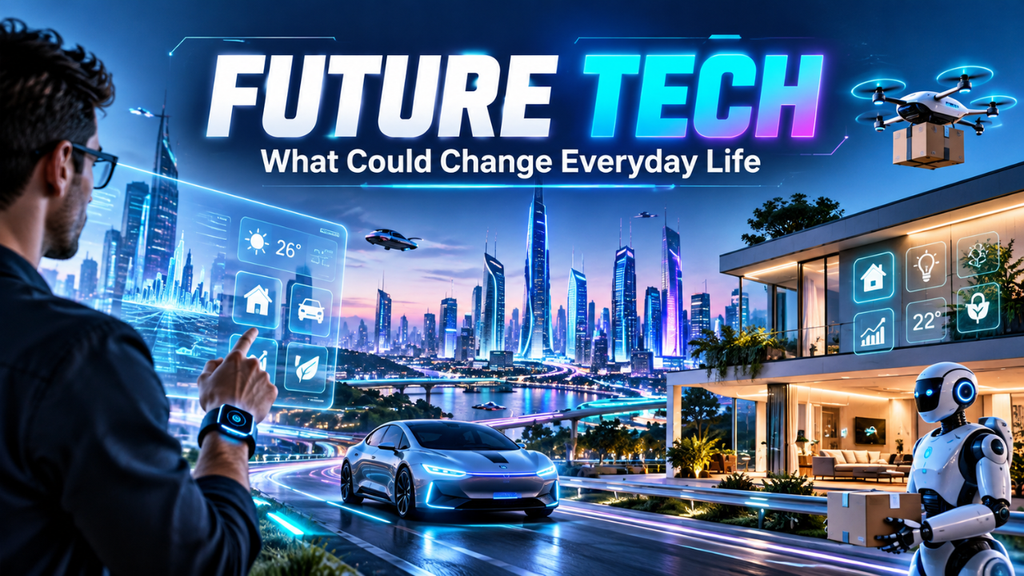
A phone that lasts through a long day. Getting a replacement part on time can prevent a faulty machine from shutting down the entire workshop. A home that uses electricity more efficiently without making you manage five different apps. These are useful ways to picture the future.
The exciting changes won’t all arrive as dramatic inventions. Some will come from better batteries, clearer instructions, or devices that finally work together.
Future tech covers emerging technologies that could change how we live, work, communicate, and make things. The trick is knowing which developments deserve attention and which still need years of testing. You can stay curious without treating every demonstration as something you’ll soon have at home.
Table of Contents
- What Future Tech Actually Means
- Better Batteries Could Change More Than Driving
- Connected Homes Need to Get Simpler
- Robots Will Earn Their Place Through Useful Jobs
- Digital Information Could Move Beyond Flat Screens
- Making Parts Closer to Where They’re Needed
- Quantum Computing Requires Some Patience
- How to Tell Progress From Hype
- Getting Ready Without Buying Everything
What Future Tech Actually Means
A technology doesn’t become important simply because it’s new. It matters when it solves a problem well enough for people to use it repeatedly.
That distinction explains why a modest improvement can have a bigger effect than an impressive prototype. A more dependable power supply might help a small shop more than a complicated display system, even if the display gets more attention online.
It also helps to separate research, trials, and established products. A laboratory experiment shows that an idea may work under particular conditions. A pilot project tests it in a limited setting. A widely available product must survive everyday use, maintenance, and customer expectations.
Those stages can overlap, but they aren’t interchangeable. When reading about an emerging invention, look for where it’s being used and what conditions it needs. That tells you more than a confident prediction about when everything will change.
Better Batteries Could Change More Than Driving
Battery improvements reach far beyond electric cars. They can affect portable tools, household backup power, and how electricity systems store energy.
Solid-state designs use a solid electrolyte, while flow batteries store energy using liquids held in separate tanks. The U.S. Department of Energy describes these approaches as opportunities to improve performance, safety, or cost, depending on the design and application. No single battery type is automatically best for every job.
Imagine a small business with rooftop solar panels. Its busiest period comes after sunset. Storage could let it use some electricity generated earlier, though the value would depend on installation costs, usable capacity, and local electricity prices.
For a buyer, practical questions matter more than the chemistry’s name. How much energy does the system actually deliver? What does the warranty cover? Can someone nearby service it?
A promising battery becomes useful when the whole system works reliably and makes financial sense.
Connected Homes Need to Get Simpler
Let’s be honest: a home doesn’t feel especially smart when changing one light requires finding the right app.
Compatibility is one of the more useful areas to watch. Matter, a connectivity standard developed by the Connectivity Standards Alliance, helps compatible devices communicate across supported platforms. It also supports local connections, so some interactions can happen within the home network. Remote access still needs an internet connection through a suitable controller or device.
Picture a household buying a lamp from one brand and a sensor from another. Shared standards can make coordination easier, although buyers still need to check the exact models, controllers, and supported features.
The next improvement you notice might be fewer setup problems rather than another voice command.
Start with one recurring annoyance, such as lights left on in an empty room. Then check whether the proposed setup fixes it without adding subscriptions or awkward controls.
Robots Will Earn Their Place Through Useful Jobs
A robot doesn’t need to look like a person to be valuable.
Professional service robots already move goods and clean floors. The International Federation of Robotics identifies transportation, logistics, and professional cleaning among their established applications. These are specific jobs with results that operators can measure.
Consider a warehouse employee who spends hours pushing a trolley between two areas. A mobile robot could handle some of those trips while the employee deals with packing errors or unusual orders.
Whether that arrangement helps depends on the workplace. Narrow routes, changing layouts, maintenance, and safety procedures all affect the outcome. A demonstration on an empty floor doesn’t answer those questions.
For workers, learning how to operate, supervise, and troubleshoot equipment may become useful alongside existing skills. For employers, the sensible starting point is a clearly defined task. Measure the time saved, interruptions, and extra support required before expanding.
Digital Information Could Move Beyond Flat Screens
Augmented reality adds digital elements to what you see in the real world. That could make instructions easier to follow when the task involves something directly in front of you.
NASA has documented technicians using augmented reality during Orion spacecraft assembly, with instructions displayed over the hardware. It’s a concrete example of information appearing where work happens.
A similar approach could help a trainee identify the right component during maintenance. Someone planning a room might preview where furniture would fit before moving anything.
Still, an overlay has to line up accurately and remain readable. Headset comfort, battery life, and the effort needed to prepare instructions can determine whether the idea is practical.
The useful test is straightforward: does seeing information this way help someone complete a task? If a normal screen works just as well, there may be little reason to change.
Making Parts Closer to Where They’re Needed
Additive manufacturing, commonly called 3D printing, builds objects from digital designs by adding material layer by layer. NIST explains that it can produce complex shapes and reduce material waste compared with some conventional manufacturing methods.
One interesting possibility is making suitable parts near the place they’re needed.
Imagine a repair workshop needing a small plastic cover for an older machine. If it has an appropriate design and material, printing the cover could be more convenient than sourcing a whole replacement assembly.
That example doesn’t mean every component should be printed. A decorative cover and a part carrying heavy loads have different requirements. Strength, heat resistance, accuracy, and testing matter.
For small businesses, experimentation can start with prototypes, display pieces, or simple fixtures that hold items during work. Compare the complete cost, including design time and failed attempts. The advantage comes from choosing a suitable use, not simply owning a printer.
Quantum Computing Requires Some Patience
Quantum computing attracts attention because it offers a different approach to certain difficult calculations. Its potential includes studying molecules and materials in ways that could support scientific research.
NIST explains that these possibilities depend on building sufficiently capable, reliable systems. Quantum information is fragile, and errors remain a major challenge. A quantum computer also isn’t a universally faster replacement for an ordinary computer.
For most readers, this is a field to understand rather than a purchase to plan.
Its eventual effects could arrive indirectly through research and industrial applications. That makes it interesting even if you’ll never operate the equipment yourself.
When a headline announces a breakthrough, check what calculation was performed and whether it has practical value. Progress on a narrow research problem can be significant without meaning that a general-purpose machine is ready for everyday tasks.
How to Tell Progress From Hype
Here’s the thing: an impressive demonstration leaves out much of what makes a product useful.
You may see the successful attempt without seeing the preparation, failed runs, or people standing nearby to help. That doesn’t invalidate the achievement. It does limit what you can conclude.
Look for evidence from ordinary conditions. Has the technology worked outside the laboratory? Are customers using it repeatedly? Does the reported improvement include setup and maintenance time?
Costs deserve the same attention. A machine might save labour during one task but require expensive servicing. A connected device might be affordable upfront while adding a monthly fee.
Claims about sustainability need context, too. Using less material during production is useful, but energy consumption, lifespan, and disposal also affect the result.
A good habit is to describe the benefit plainly: “This reduces a job from two hours to one.” If the advantage stays vague after removing the impressive terminology, it probably needs more investigation.
Getting Ready Without Buying Everything
You don’t need to chase every development to prepare for change. Start with the problems you already understand.
A business owner might track downtime before exploring new equipment. A household could check electricity usage before considering storage. A student can build confidence with digital tools and technical basics while following one area of interest.
Small trials make learning manageable. Set a clear goal, keep the cost reasonable, and decide what evidence would justify continuing.
Future tech becomes valuable when it makes daily life or work better in a way you can recognise. Stay interested, ask practical questions, and give promising ideas room to prove themselves. You can welcome progress while choosing your own pace.





3 thoughts on “Future Tech: What Could Change Everyday Life”