Ambient Intelligence Technology: How It Works in Real Life
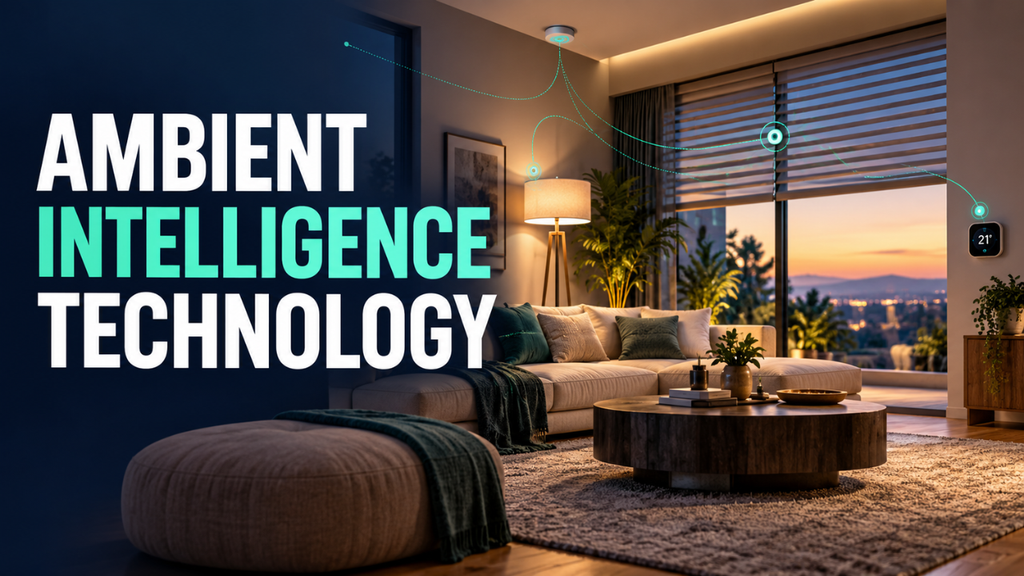
You walk into the kitchen with both hands full. The lights come on, but only as brightly as the early morning needs. Later, when everyone leaves, the heating eases off without someone opening an app.
That’s the promise of ambient intelligence technology: surroundings that respond to people with less effort from them.
It sounds simple. Getting it right is harder. A home has to distinguish an empty room from someone quietly reading. A workplace needs to improve comfort without making employees feel watched. The interesting question is how these systems can become helpful enough to trust.
Table of Contents
- What Is Ambient Intelligence Technology?
- How a Space Learns to Respond
- How It Differs From Ordinary Smart Devices
- Where It Can Make Everyday Life Easier
- Why Care Settings Need Extra Caution
- The Privacy Question Is Personal
- When the System Gets It Wrong
- The Best Systems Leave You in Charge
What Is Ambient Intelligence Technology?
Ambient intelligence technology combines sensors, connected devices, and software to create spaces that can recognize situations and respond appropriately. Researchers often shorten the term to AmI. The central idea is that computing becomes part of the surroundings, helping people without demanding constant attention. Research describes this relationship between sensing, reasoning, and action.
The word “ambient” matters. The technology operates quietly in the background, integrated into rooms, household appliances, lighting, and other everyday items.
A basic motion sensor can switch on a light. A more capable system might also consider daylight, the time, whether someone is sleeping nearby, and a person’s chosen brightness. Its response depends on context.
That doesn’t mean it understands people perfectly. It makes estimates from the information available, sometimes using learned patterns and sometimes using carefully designed rules.
How a Space Learns to Respond
Everything starts with a signal. A sensor detects movement, measures temperature, registers a door opening, or checks how much daylight enters a room.
Software then interprets those readings together. One signal rarely tells the whole story. An open door could mean someone arrived, someone left, or a breeze pushed it. Combining several clues can make the interpretation more useful. This kind of context awareness is a central part of ambient intelligence research.
Next comes the response. The system might adjust the cooling, lower a blind, or send a notification. In some designs, repeated manual corrections help it refine future choices.
Imagine someone who usually comes home at six. A schedule alone might cool the house every evening, even when they’re away. A context-aware setup could combine their permitted location information with indoor temperature and occupancy before acting.
Processing may happen on a device, a nearby hub, remote servers, or a mixture of these. That choice affects response time, internet dependence, and where personal data travels.
How It Differs From Ordinary Smart Devices
A connected device isn’t automatically an ambient intelligence system.
A lamp controlled from your phone still waits for instructions. A timer follows a fixed schedule. Both can be useful, but neither necessarily adapts to what’s happening around it.
The Internet of Things, or IoT, provides ways for physical devices to collect and exchange information. Ambient intelligence uses such connections, along with sensing and decision-making, to support people within a space.
There’s overlap. The difference is mostly about behavior and purpose, rather than a neat dividing line between product categories.
Now, consider a meeting room. Someone could manually turn on its connected lights and adjust the thermostat. A more responsive setup could use occupancy, daylight, and room temperature to manage those settings together.
It should still allow someone to change them. An automatic choice can be sensible and still be wrong for the person sitting there.
Where It Can Make Everyday Life Easier
Home is an obvious place to start because small frustrations repeat there every day.
Picture a hallway at night. A well-designed setup could provide a soft path of light when someone gets up, then fade it once they’ve returned to bed. Full brightness would be annoying. No light might make the walk difficult. The useful response sits between those extremes.
Heating and cooling offer another practical example. A system could take account of which rooms are occupied and how sunlight affects them, while respecting the limits residents set.
Offices have similar possibilities. Consider a room that’s comfortable with two people but stuffy with ten. Occupancy and environmental readings could help the building adjust ventilation as conditions change.
There’s a potential energy benefit when equipment avoids serving empty spaces unnecessarily. Still, savings depend on the building, its equipment, and how the system is configured. Extra sensors alone don’t guarantee a lower bill.
I think these ordinary improvements are more convincing than a house packed with attention-seeking gadgets. Fewer interruptions can be a benefit by itself.
Why Care Settings Need Extra Caution
Ambient sensing also has a role in research on hospitals and supported living. Researchers have explored using contactless sensors to observe movement, track activities, and support tasks such as checking hand hygiene. Stanford researchers describe both these possibilities and the challenges involved.
For someone living alone, a well-designed system could detect unusual changes in their daily routine and notify a designated contact to check on them.
The important word is “might.” A quiet morning could mean trouble, or it could mean the person decided to sleep late. A detected event needs interpretation and a clear response plan.
Monitoring only helps if the right person receives a useful alert and knows what to do with it. Testing, consent, and dependable human follow-up matter as much as detection.
These systems need to support care without creating false confidence about what they can notice or prevent.
The Privacy Question Is Personal
Let’s be honest: a room that notices your habits can also reveal them.
Even without recording audio or video, data from doors, motion sensors, and connected devices can reveal when someone is at home and what their daily routine looks like. Research on smart home privacy has highlighted risks from drawing conclusions using data from devices without microphones or cameras.
So privacy needs to be part of the design from the beginning.
A useful starting point is collecting only what’s needed for a clear purpose. A room may need an occupancy count to manage ventilation; it may have no reason to identify everyone inside.
Keeping processing local can reduce the information sent elsewhere, though it doesn’t make a system automatically private or secure.
People also need understandable answers about who can access their data, how long it’s kept, and how monitoring can be paused. Visitors and employees deserve consideration too. Buying a device doesn’t settle those questions for everyone around it.
When the System Gets It Wrong
The most irritating failures are often small.
A light switches off while you’re reading because the sensor hasn’t detected enough movement. Blinds close during a video call. A room changes temperature because one person’s preference overrides everyone else’s.
These moments expose a basic limitation: detecting a signal isn’t the same as understanding a need.
Shared spaces make that especially obvious. One person likes a cool bedroom; another reaches for a blanket. There’s no single “correct” preference for the software to discover.
Then there are practical failures: flat sensor batteries, interrupted connections, unavailable remote services, or devices that stop working well together.
Security maintenance matters as well. NIST research on smart home updates identifies updates as an important way to address device vulnerabilities.
A dependable design needs a fallback. People should know what happens during an outage and retain a straightforward way to operate essential equipment. An unreliable internet connection shouldn’t turn switching on a room light into a troubleshooting session.
The Best Systems Leave You in Charge
For anyone considering ambient intelligence technology, I’d start with one recurring problem.
Perhaps a hallway is difficult to navigate at night. Maybe an office wastes energy conditioning unused rooms. A narrow goal makes it easier to judge whether a system actually helps.
Ask what information it needs, how it behaves when uncertain, and whether people can easily correct it. Check compatibility and ongoing support before making more devices depend on one another.
Try the setup under ordinary, messy conditions. Have guests over. Change the routine. Sit still for a while. The exceptions reveal more than a polished demonstration does.
The future I’d find useful is a space that handles small tasks quietly, explains its choices when asked, and accepts a correction without a struggle.
Ambient intelligence earns its place when daily life feels easier and people remain comfortable with how that happens. The lights can come on by themselves. The choice about how you live should stay yours.






2 thoughts on “Ambient Intelligence Technology: How It Works in Real Life”